
Reviewing Stratechery
Ben Thompson's publication has the latest information about the growth and trends of AI and technology.

Ben Thompson’s Stratechery is an extremely popular one man blog covering tech trends and insights. This blog, Singulariti, is loosely based on Stratechery, but with a focus on AI. Thompson has already written extensively about his thoughts on AI, and it wouldn’t make sense to start from scratch. The purpose of this article is to summarize what is freely available on Stratechery (not behind a paywall).
I’m reviewing Thompson’s work first because Stratechery is widely considered the holy grail of technology writing. Thompson’s articulation of tech trends over the years have already shaped startup and enterprise strategy. He has a very good pulse on what is happening in technology. We can use his writing as a well positioned starting point for diving deep into artificial intelligence.
Let’s get started.

In each section, I’ll link to Thompson’s writing before summarizing each concept.
If you’d like to skip my summaries and go straight to each article, I’ve listed them here:
Defining Artificial Intelligence
The following section is from this Stratechery post from 2017.
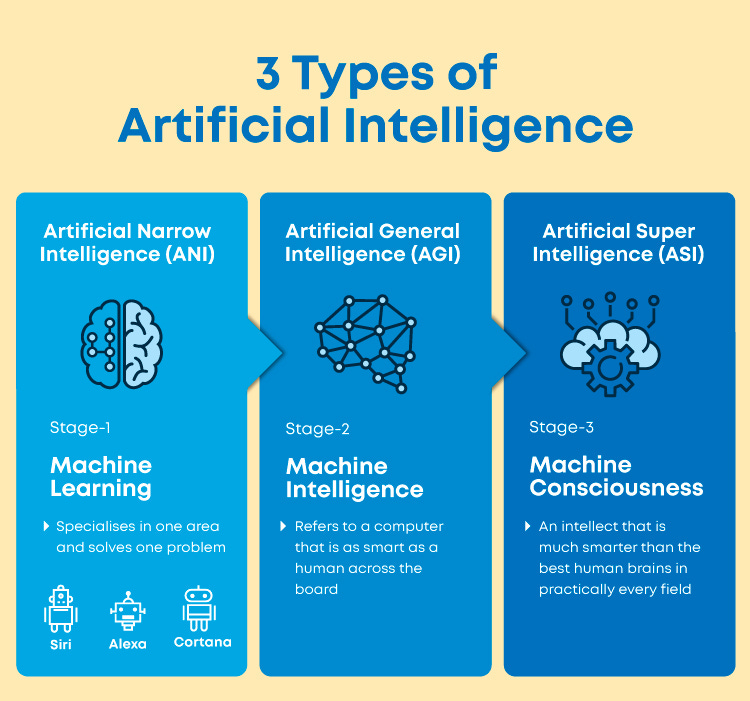
The internet believes that there are three general categories of artificial intelligence.
Narrow Intelligence
General Intelligence
Super Intelligence
We should be scared of the latter two. Why? We’ll get to that in a later article.
The world right now lives with narrow intelligence. It’s also the easiest to understand. Software created to do one task really well, such as recognizing text or navigation, is considered narrow intelligence. Often, we interact with narrow intelligence systems through an application on our phone or on a computer. More importantly, we are aware that we are interacting with artificial intelligence. Thompson calls narrow intelligence “taken for granted AI”.
Keep this last point in mind as we transition into describing general intelligence.
The second category is general intelligence. While narrow intelligence is good at one task, general intelligence is as smart as a human, and can learn at the level of an average human. I predict that at this point, the intelligence actor would be indistinguishable from interacting from another human. How humans will interact with general intelligence is still being debated. Interfaces like ChatGPT lead me to believe we will mainly use text inputs. More on that later.
The last category is super intelligence. This would be a computer or machine actor that is vastly smarter than the human brain with an incomprehensible difference in computational power. This part is scary. Humans would not be able to tell how much smarter the machine is in a few areas, namely social skills and scientific creativity.
In the final part of this first article, Thompson debates a few ethical questions surrounding Life & Meaning. He says:
“The price we pay for technology progress is all of the humans that are no longer necessary.”
Ben Thompson
He’s asking the right questions. By building better machines, are we making swaths of humans irrelevant? Will the meaning of life be destroyed by machines that perform better than we do?
Here, I think Thompson is referring to the idea of processes and “labors of love”. If machines take away the act of doing something by automating, will life still be meaningful as a construct? Based on his writing, Thompson doesn’t quite know the answer.
How does AI distribute ideas?
The following section is from this Stratechery post from 2022.
The next article I could find about AI on Stratechery is in this year, 2022. This means that for five years, Thomspson did not release an article publicly with AI as a focus. It is quite possible that a daily update article had AI as a focus. In addition, Thompson wrote about AI three separate times in 2022. Artificial intelligence has gone mainstream.

In this article, we delve into how AI distributes ideas. In the past, ideas were propagated, or in this case, distributed orally. After more technological progress, ideas were distributed through print, and then through the internet. Per Thompson, there are five steps in the propagation value chain:
Creation
Substantiation
Duplication
Distribution
Consumption
Over time, each step of the process was unbundled from the others in the value chain. Up to when Midjourney (AI image generation) was released this year, creation and substantiation were still bundled together. For example, if Thompson has an idea, he has to write it down and publish it on Stratechery. The internet will take care of duplication, distribution, and consumption.
Now, creation and substantiation are being separated from one another. If you have an idea for art, for example, AI can substantiate and make it for you. Here is an example:

The whale above is not exactly what I had in mind. Perfect execution of a creator’s vision will only happen if creation and substantiation stay bundled. As a part of this unbundling, ideal execution of an idea will have to be put on hold. Likely, economic value will be at either extreme of this spectrum: zero marginal cost content and perfectly bundled creation and substantiation.
Text to everything
The following section is from this Stratechery post from 2022.
If you aren’t in the know, Roon is an anonymous AGI researcher and popular twitter personality. His work includes a viral piece about wordcels and hot takes on twitter. There is, however, one piece of writing that articulates tremendous value for where we are right now in AI. Roon argues, as the title says, that Text is the Universal Interface. Put simply, “text to everything”.

The initial input will be text. From text, we’ll first get photos and art (ex: Midjourney), then video, and finally 3D images and assets. But the flow above is a bit misleading. Here is a better representation of what might happen:
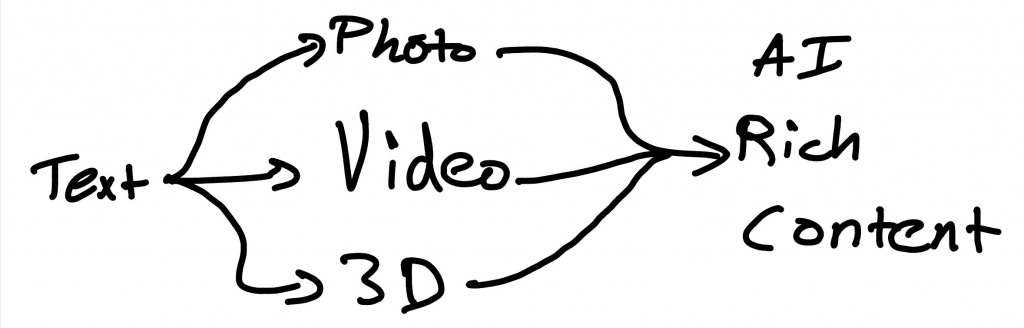
The last element is code (like Copilot) and compute. With the release of these AI systems, the cost of creating a pieces of art, videos, or 3d assets goes to zero at scale. As a symptom, the cost of content creation goes to zero. Thompson calls this Zero Marginal Content. The cost to consume content through the internet is already zero, so what happens if the cost of creating that content also goes to zero? Thompson argues that each lived experience on the internet (and in the metaverse) will become more unique than it already is.
As a final note in this article, Thompson brings up the philosophical and ethical questions surrounding AI. He has an acute understanding that the economy will change and bend to accommodate AI and that ethical questions about human productivity will be at the center of it.
The ChatGPT
The following section is from this Stratechery article from 2022.
In his final public post on AI in 2022, Thompson marvels at just how good ChatGPT is.
Here is ChatGPT describing what it can do:
As an AI language model, I can understand and generate human-like text, and can respond to a wide range of questions and prompts. I can provide information and explanations on a variety of topics, including science, history, mathematics, and current events. I can also assist with tasks such as translation, summarization, and text generation. I can engage in natural, human-like conversation and can help clarify and expand upon information you request. I am not able to browse the internet or access new information outside of my training data, so I may not be able to answer questions about very recent events or topics that were not included in my training data. However, I can still provide useful information and insights on many topics. Is there anything specific you would like to know more about?
ChatGPT on ChatGPT
ChatGPT answer most questions and requests correctly. I believe that Thompson is hesitant to comment on this. As OpenAI and other companies continue to throw increasing amounts of compute and dollars at training models, each subsequent model gets better than the next. As models get better, “homework and other jobs will be disrupted by AI”.
The final idea of this article is the AI Capability Overhang. Thompson writes that right now, AI can accomplish tasks that entrepreneurs and product people haven’t grasped yet. There is “capability” that we haven’t articulated, and thus don’t know about AI. Simply put, we haven’t let humanity figure out what to do with AI. The time will come.